
The members of Södra are family foresters, often for several generations
The members' forest estates are owned and managed long-term by families, often over several generations. Södra supports its members with advice and services for long-term and climate-adapted forestry – from seedling selection and stand management to monitoring growth and harvesting. The harvest rate is kept within sustainable levels in the long term, and thus the forest can continue to be used as both a resource and carbon stock over time.
Södra's members manage their forests in Götaland for the long term, often for several generations. Since the members may have different goals with their forest ownership, the forest is managed in a varied way. Södra offers a wide range of advisory services and services in forestry.
Forest growth – vigorous high-growth forests
A high rate of forest growth helps to maintain and develop many of the values of family forestry, including its profitability. Södra applies a long-term approach when developing forest management methods and advice to members. The roadmap for higher forest growth identifies key areas: higher seedling survival rate, efficient stand management, forest tree breeding, site adaptation and damage reduction. Continued investments in research and development are required to implement the changes.
Climate-adapted forests
Forestry needs to be adapted to climate change to meet a warmer climate. Site adaptation is a key tool, which means choosing the right tree species at the right place – for example, more pine and less spruce. Pine is more resistant to drought and storms and important for biodiversity. More tree species are also used to spread the risks. Forest tree breeding, i.e. producing trees that grow better, means that the forest can adapt faster. Pine and spruce in our own production come from third-generation processing, which on average gives 22 percent higher growth for pine and 25 percent higher for spruce. Knowledge and learning are important for enabling members to make well-informed decisions about their forestry.
Growing stock – the forest's stock of raw material
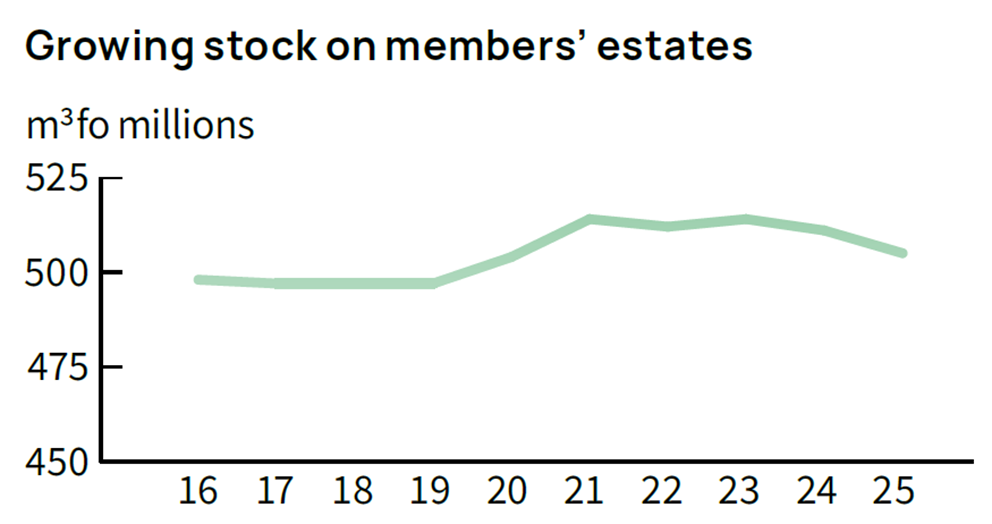
The growing stock on forest land on the member’s estates is based on statistics from the Swedish National Forest Inventory. The growing stock has been increased over a long period of time. Research and development, and the high ambitions of forest owners when it comes to forest management have contributed to this high rate of growth. The growth has been lower in recent years, which the Swedish National Forest Inventory also shows for the whole of Götaland, while the harvest rate has been high, but has now fallen slightly. One explanation for the lower growth could be the severe drought in 2018 and its subsequent effects but even at national level growth has declined over the past 10-15 years. This year's statistics from the Swedish National Forest Inventory show a slight increase in growth compared with the previous year, indicating that the downward trend in growth in recent years may have been broken. The margin between growth and harvesting in Götaland will not be as great in the future, which could lead to less growing stock and subsequently net CO2 emissions for individual years.
Harvesting level
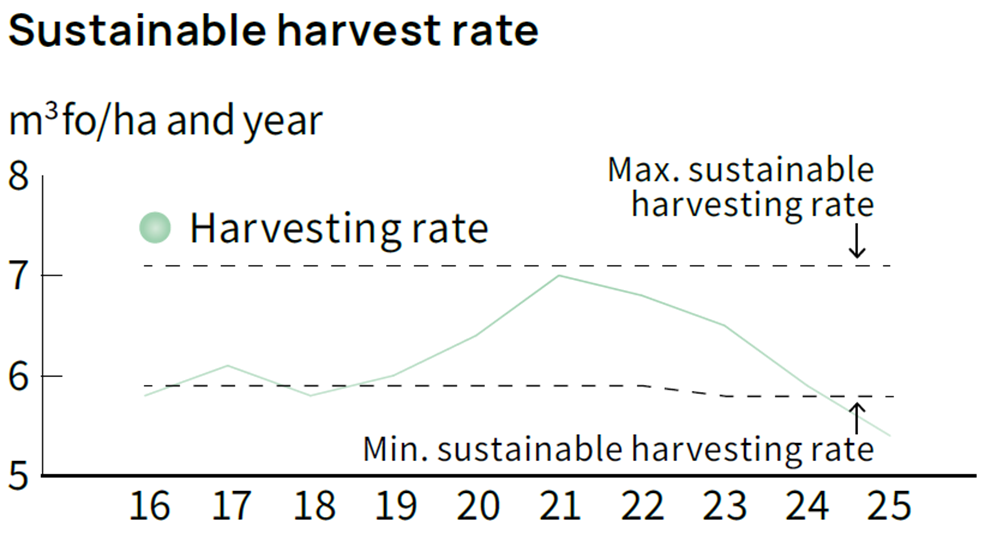
The basic principle is that the harvest rate over time should not be higher than forest growth. The sustainable harvesting rate for members of Södra is 5.8–7.1 m³fo per hectare per year (a total of 14–17 million m³fub per year). Södra's harvesting rate in 2025 was 5.4 m³fo per hectare per year – lower than what Södra defines as a long-term sustainable harvesting rate for optimal utilisation of members' forest raw materials.
Method
The harvesting rate is based on statistics from the Swedish National Forest Inventory for Götaland. The harvesting rate for 2025 is a mean of three seasons, from first bud burst in 2021 to first bud burst in 2024. Calculation of the long-term sustainable harvest rate is based on the forestry impact assessments carried out by the Swedish Forest Agency and the Swedish University of Agricultural Sciences (SLU). The most recent analysis was carried out in 2022 and Södra chose Today’s forestry (Sw: Dagens skogsbruk) as its scenario, since it best reflects Södra’s forest management strategy.
Climate effect (carbon sink)
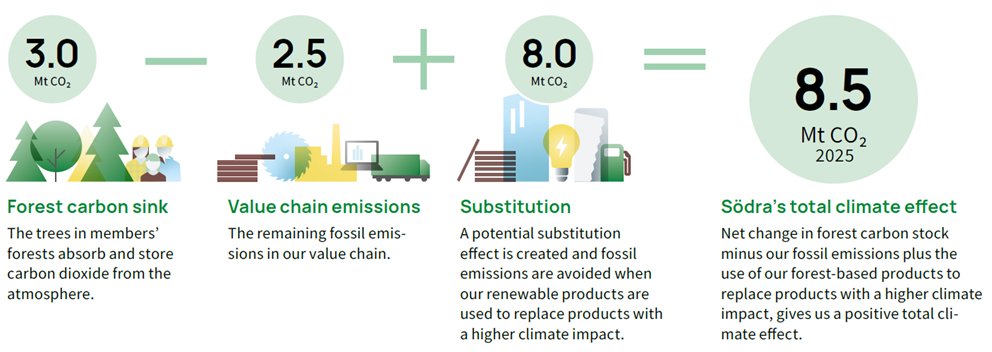
Growing forests bind carbon dioxide by the trees absorbing and storing carbon dioxide from the atmosphere. In Sweden, the timber supply, i.e. the amount of wood in the forest, has been increasing for a long time and is now larger than ever, although the growth rate is now starting to level off. As the forest grows more, carbon dioxide uptake also increases, which means that the forest acts as a carbon sink.
Family forest owners’ objectives
Passing on a well-managed forest to future generations is the most important objective for Södra’s family forest owners. Financial returns and timber production are also highly prioritised, while many forest owners value biodiversity, recreational benefits and climate-related benefits alongside economic goals. Based on responses from Södra’s Member Survey 2026, forest ownership is characterised by a combination of long-term stewardship and active forest management.
Source: Södra Member Survey 2026. Responses to the question: “What are your objectives for forest ownership – which three objectives do you prioritise most?”