
Our products are made from renewable forest raw materials and can replace fossil-based alternatives
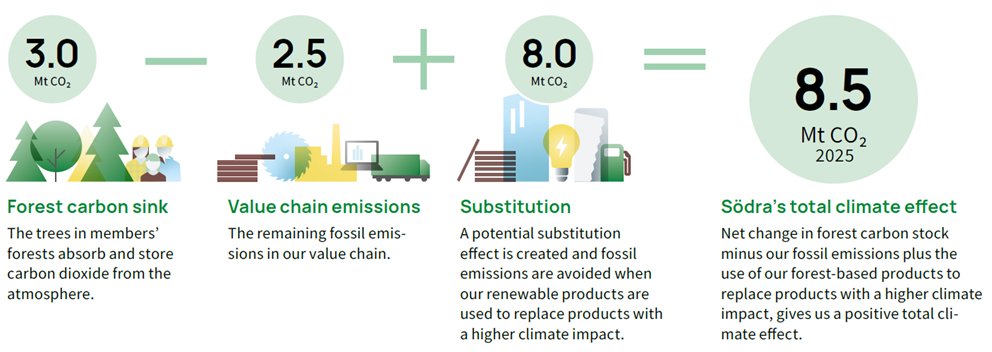
In a wide range of applications, Södra's products made from renewable forest raw materials can replace fossil-based alternatives. The potential climate benefit of using bio-based products instead of fossil-based products is referred to as substitution and is one of three components of Södra's total climate effect model. The other two parameters are the net sink of carbon dioxide in the members' forests and the fossil greenhouse gas emissions in the value chain.
Bio-based products from biological resources
Södra's products are bio-based, which means that they mainly consist of renewable biological resources – not fossil raw materials such as oil, coal or gas. The carbon in the products is biogenic and part of the natural carbon cycle. This distinguishes them from fossil-based products that add new carbon to the atmosphere.
Södra's total climate effect
Södra's total climate impact is calculated in a model with three input parameters:
- Net change in forest carbon stock
- Fossil greenhouse gas emissions in the value chain
- Substitution – potential for avoided fossil greenhouse gas emissions
Net change in forest carbon stock
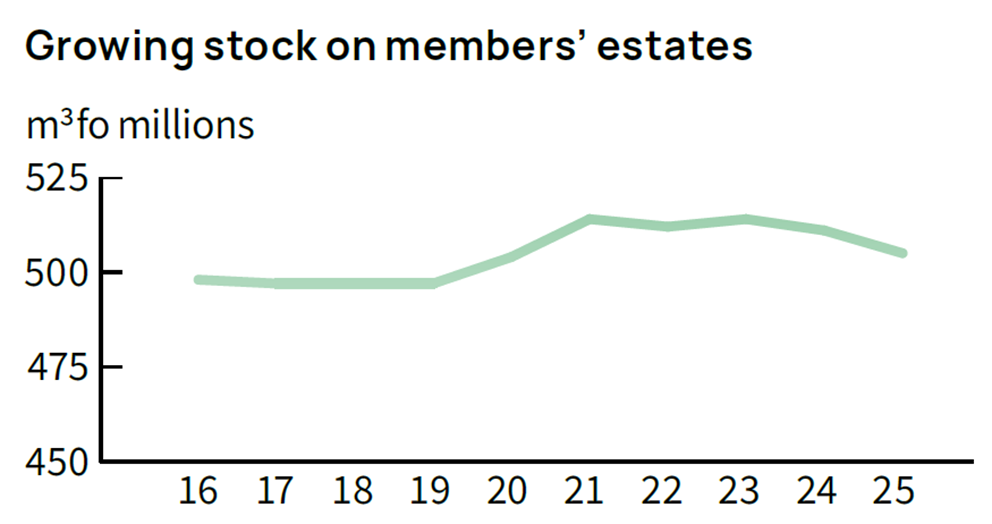
The trees in the members' forests absorb and store carbon dioxide from the atmosphere. As the forest grows, carbon dioxide is sequestered. According to the Swedish National Forest Inventory, forest growth is increasing and the growing stock in Sweden is now larger than ever before. The growing stock is the amount of biomass in the form of wood that is found in the forest. At the same time, the growth rate has begun to level off somewhat. The net storage of carbon dioxide is dependent on the balance between growth and harvesting. Variations between years are therefore affected by both the weather and demand for Södra's products.
Fossil GHG emissions in the value chain
Södra's emissions of fossil GHG in the value chain are divided into three parts.
- Direct emissions (scope 1) occur in operations where Södra has financial control, for example from boilers, forklifts and trucks.
- Indirect energy emissions (scope 2) are relatively limited because electricity and heat are largely produced in the company's own industry.
- Other indirect emissions (scope 3) include purchased goods and services, transport, waste, business travel, commuting, and further processing, use and disposal of sold products.
Södra's climate targets have been approved by the Science Based Targets initiative (SBTi). The goal is to reduce emissions by 50 percent by 2030 compared to 2020. For further processing of sold products, there is also a commitment target: customers corresponding to 70 percent of the emissions will have set their own SBTi targets by 2027.
Substitution – potential for avoided fossil emissions
Products made from renewable forest raw materials can replace fossil-based alternatives in some applications – for example, wood instead of steel or concrete in buildings, and biofuels instead of fossil fuels. Potentially, a substitution effect is created when fossil emissions are avoided. The climate benefit depends on the product, use and which alternative that is compared.
About the method
The model for climate effect shows the total climate impact of forests and forest-based products, signalling the importance of active forest management. The substitution effect should be considered a potential for avoided emissions, with the reduction taking place in other sectors. The substitution factors are conservative and based on scientific publications and there is a major variation between different publications. An international standard for the model was developed in 2025 and Södra’s implementation will take place in 2026. The implementation may involve an adjustment of the substitution factors.
| Forest-based product | Substitution factor, tonne of fossil carbon replaced per tonne of biogenic carbon in the forest-based product |
|---|---|
| Wood raw material | 0.5 |
| Biomaterials (wood chip and sawdust for material purposes) | 0.9 |
| Sawn timber | 1.5 |
| Paper pulp | 0.7 |
| Dissolving pulp | 1.0 |
| Energy and biochemicals | 0.7 |