
Södra works actively with nature conservation that strengthens the conditions for biodiversity in the members' forests
Södra supports its members in responsible forestry through forest certification, green forest management plans, nature conservation management and nature conservation premiums. The consideration is followed up annually through the Green Balance Sheet and further developed through research collaborations and a future nature conservation programme.
The forests in Södra are owned by the members. Södra as a cooperative offers advice, nature conservation services and certification within group certificate.
Biodiversity is a prerequisite for sustainable forestry and for Södra's business model to be sustainable in the long term. The work is based on the members' voluntary set-asides, nature conservation management and the environmental consideration that is taken into account in all forest measures.
Group Certification
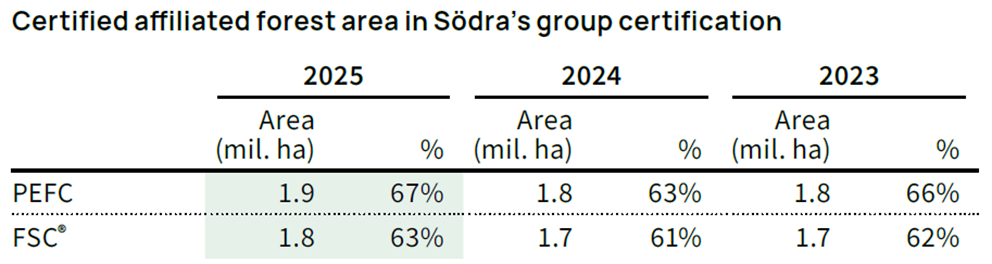
The forest certifications PEFC and FSC® are important tools for responsible use of the forest. Forest owners can join Södra's group certificate and then commit to complying with the certification requirements, with follow-up through annual audits. The certification means that the forest owner takes more nature consideration than what is required by law. As compensation, Södra pays a certification premium for the delivery of timber.
Green forest management plans for long-term management
The forest management plan shows how each part of the forest should be managed in the long term, so that we both produce wood and take nature and people into account. The plan also takes into account aquatic environments (blue target classes). The plan is based on knowledge of what the forest looks like in different parts of the landscape (forest nature value regions).
Green Balance sheet evaluate consideration
In Södra's follow-up of considerations, Green Balance Sheet, regeneration harvest, thinning operations, nature conservation measures and regeneration operations are audited and rated each year based on the consideration that has been taken. Young stand thinning is also included as of 2025. The inspections out in the forest (the field work) are carried out by Södra's forest management auditors.
Result Green Balance Sheet
A total of 480 areas were audited in the Green Balance Sheet in 2025, which corresponds to 2,145 hectares (2,685). The aim is that all regeneration harvest will achieve an acceptable result (100 percent) for sensitive habitats, wastelands, buffer zones and protection zones, impact on soil and water, and cultural environments. For the other main functions, the aim is a satisfactory result of 95 percent.
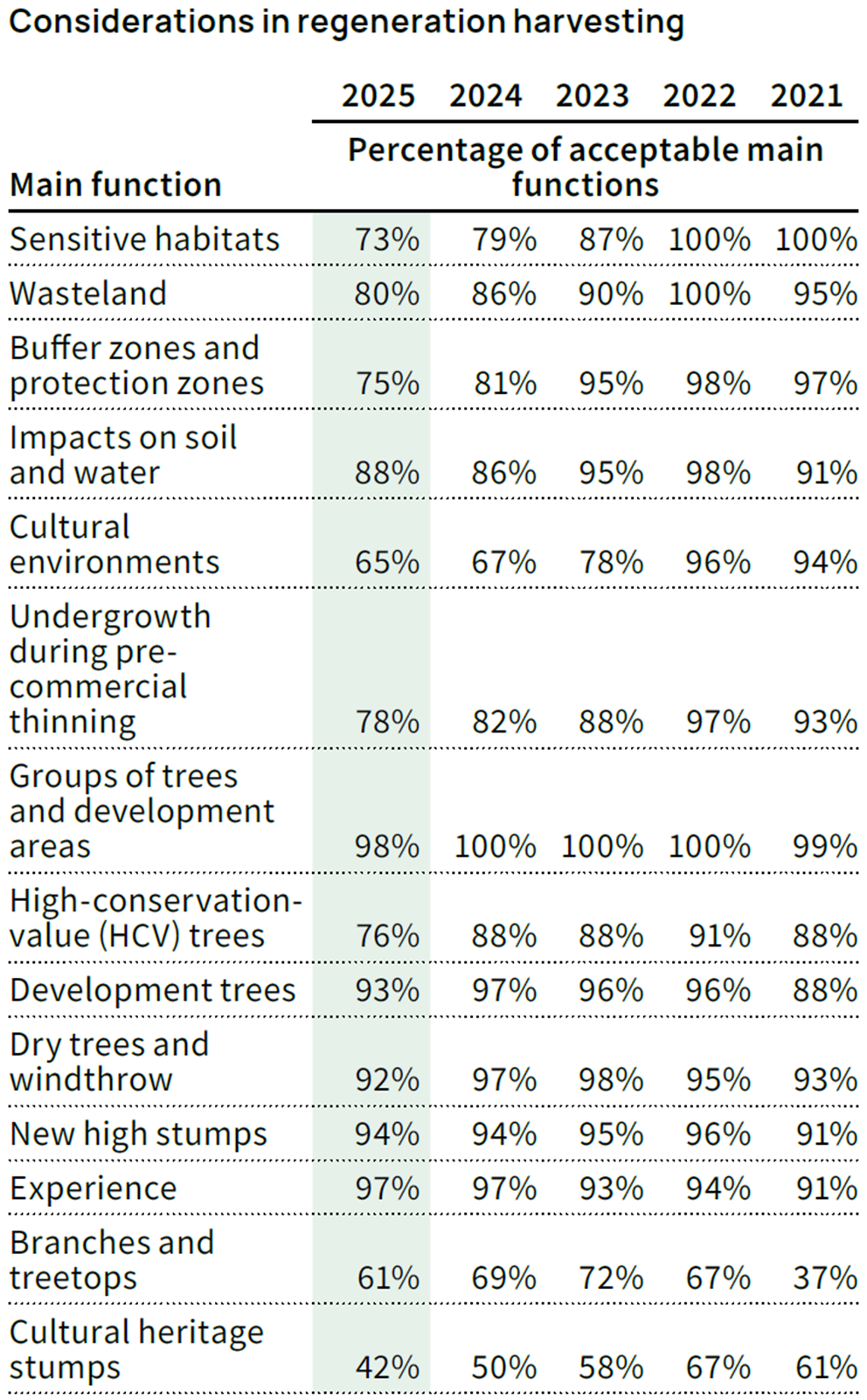
There are still challenges in reaching the target of approved ratings in the Green balance sheet. During the year, competence development of contractors was intensified to ensure a high level of awareness of consideration measures in the forest. A training programme with regular refresher training will be introduced in 2026. Local action plans will also be developed to improve performance and coaching will continue of contractors.
General environmental considerations
In all forestry operations, Södra applies general environmental considerations to combine production with nature conservation, cultural environments and social values. This means that forestry operations are planned and performed taking into account biodiversity, cultural environments and people's needs. Some examples of general environmental considerations include:
- Sensitive habitats such as watercourses, screes and other areas with high conservation values are preserved
- Buffer zones towards lakes and watercourses where deciduous trees and shrubs are left
- High-conservation-value trees and dead wood are saved
- Cultural environments and cultural remains are protected
- Urban forests and along paths and trails are adapted for outdoor recreation
Voluntary set-asides and nature conservation management (NS)
The biodiversity agenda is based on the members’ voluntary set-asides, nature conservation measures and the environmental consideration to which all forestry measures are subject. The forest land of southern Sweden boasts a wide variety of habitats, creating a rich environment. Many of these values are dependent on active management for its preservation and development. That is why we have set a target to carry out nature conservation measures (NS) on 3,000 hectares annually. In 2025, activities were intensified compared with the preceding year, and this has borne fruit – in 2025, 3,086 hectares were subject to nature conservation measures (NS).
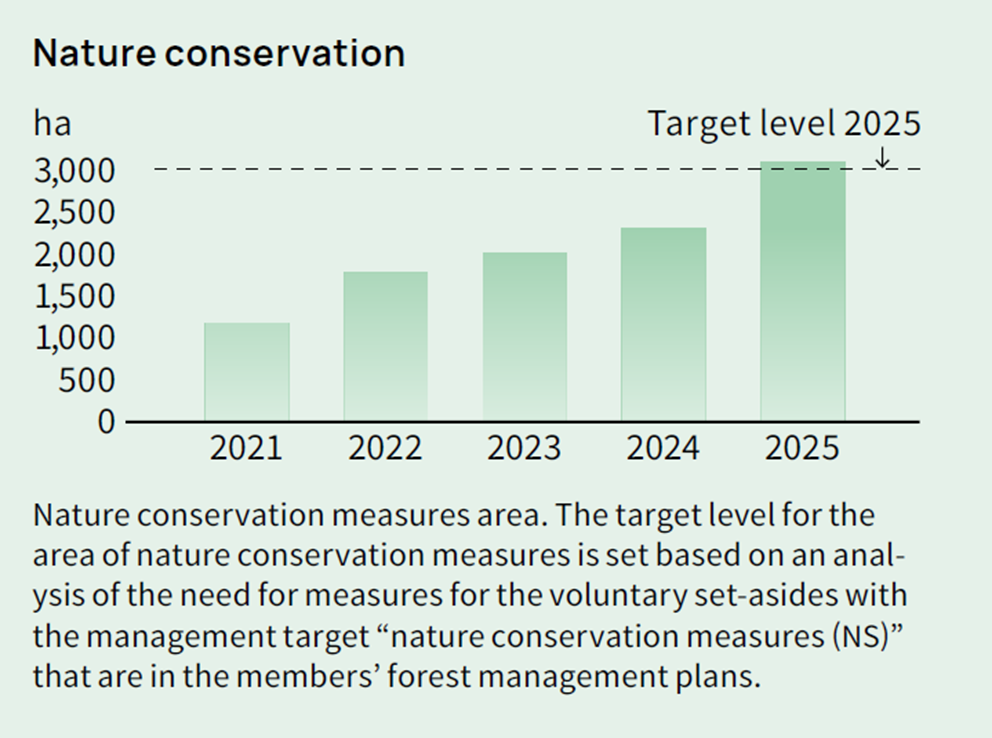
Södra works to preserve and promote biodiversity – a process under continuous development. The aim is that Södra will pursue a richer biodiversity for future generations. In Götaland, nature conservation measures are important for the preservation and promotion of biodiversity. Södra’s target for nature conservation measures is an area corresponding to 3,000 hectares per year until 2025. The outcome for 2025 was 3,086 hectares (2,310). For 2026, the target of 3,000 hectares of nature conservation measures remains. More key indicators for measuring the effects of measures to preserve and promote biodiversity are under development.
Nature conservation premium for extra nature conservation
Forest owners who set aside more forest for nature conservation than the certification requires receive an extra compensation during harvesting – up to SEK 25 per m3 solid volume under bark for all timber from the property. The premium was introduced in 2022 and interest in voluntary set-asides is increasing.
Focus on species management
Södra works with nature conservation in the forest and has increased its focus on individual species in recent years. The work includes analysis of important habitat types and priority species – species that require special consideration. A total of 340 species have been identified and their habitat requirements have been compiled. The skills of field staff are strengthened through training in nature value assessment. Together with the Swedish University of Agricultural Sciences (SLU), a study commenced into on what environmental consideration that are needed to promote the Goodyera orchid when harvesting. Several areas are monitored over time, but it is still too early to draw conclusions.
Nature conservation programme is developed
In 2026, a nature conservation programme will be developed outlining an action plan to promote richer biodiversity. The work on priority species is anchored with authorities, researchers and environmental organisations in order to build broad consensus.
Collaboration and research for nature conservation
- Södra collaborates with customers, researchers and other stakeholders to develop and disseminate knowledge about nature conservation and biodiversity.
- Sustainability webinars for customers about nature conservation.
- Collaboration doctoral student with SLU on the effects of different forms of forest management on sensitive species.
- Participation in ISO standardization work for measurements for biodiversity in managed forest landscapes.
- Within the Swedish Biocredit Alliance: development of a standard for biodiversity credits.