In many cases, Södra’s products have a low climate impact compared with fossil-based alternatives
Södra's products generally have a lower climate change impact than fossil-based alternatives. This assessment is based on comparisons between Södra's bio-based products and corresponding fossil-based alternatives. The comparisons are based on interpretation of life cycle data from Environmental Product Declarations (EPDs), Life Cycle Assessments (LCA) and generic data from established databases.
Basis for comparison
The assessment is based on comparisons between Södra's bio-based products and corresponding fossil-based alternatives. The comparisons are based on interpretation of life cycle data from Environmental Product Declarations (EPDs), Life Cycle Assessments (LCA) and generic data from established databases. Generic data is used to represent average or industry-typical values when product-specific data is missing.
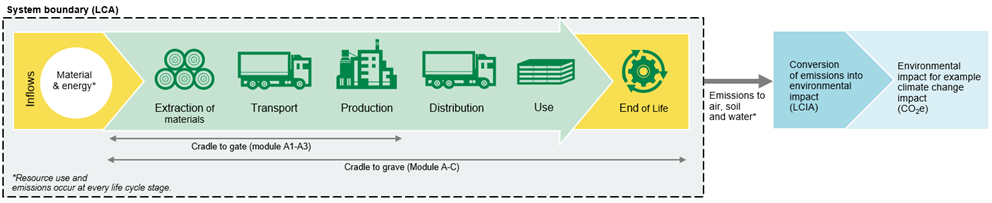
Södra works with Environmental Product Declarations (EPDs) in certain product categories (e.g. construction products) to transparently and objectively report on the environmental performance of products. An EPD is based on a life cycle assessment (LCA) that shows the environmental impact over parts of the product's life cycle, depending on the defined system boundary. For other products, LCA is used, where the climate change impact is reported as the product climate footprint (PCF).
Delimitations
The analysis includes comparisons at both material and product level, depending on what is being analysed. For some offers, such as pulp, comparisons are made at the material level, while others, such as CLT, represent finished products to a greater extent. The comparisons are based on the declared unit and therefore do not take into account function, performance or service life in specific applications. This is because a function-based comparison requires detailed information about the design, material content, use and lifespan of products, which is often not available – especially for products that are further processed outside of Södra's operations. At the same time, product-level analyses are important to fully understand climate impact in practical applications. This analysis should therefore be seen as a step towards more comprehensive comparisons at product level.
System boundaries
For Södra's bio-based products, the comparisons are mainly based on life cycle data with system boundaries from raw material extraction to finished material (cradle to gate, corresponding to modules A1–A3 according to the EPD standard for construction products). This is because waste management and end-of-life are greatly influenced by the design of the final product and the market in which it is used.
For bio-based energy and fuels, the entire life cycle, including the use phase (e.g. combustion), is included to reflect the total climate change impact.
Methodology and data quality
When interpreting life cycle data, particular consideration has been given to methodological choices such as system boundaries, declared unit, allocation principles, possible system expansion, cut-off rules, as well as assumptions, limitations and data quality.
Indicator - climate change impact
Climate change impact is reported as emissions of greenhouse gases in carbon dioxide equivalents (CO2e), which means that different greenhouse gases are converted into a common unit based on their global warming potential (GWP). The analysis focuses on the climate change impact excluding biogenic carbon dioxide, as it is considered to be part of the natural carbon cycle.
Comparability and uncertainties
The comparison is based as far as possible on equivalent conditions and choice of method. However, variations in climate change impact may occur because of differences in data sources, methodological assumptions and data quality. In cases where generic data has been used in the comparison, the results may differ from product-specific data, for example from individual companies.
The results give an indication of differences, rather than exact values. It provides an overall picture of differences in climate change impact, but are affected by choice of method, system boundary, data sources and assumptions.
Result
The results of the comparison will be published shortly.
What is an EPD?
An EPD is a third-party verified declaration that provides comparable information about a product's environmental impact. Because the LCA is carried out according to established product category rules (PCR) and is reviewed by an independent third party, fair comparisons between products within the same category are possible.
Read more: List of Södra's EPDs
What is an LCA?
A life cycle assessment (LCA) is a method for studying the environmental impact of products and services from a life cycle perspective. A life cycle is interconnecting processes in a product system, often studied from the extraction of raw materials (cradle) to the product's waste management (grave). By studying the entire product system, from cradle to grave, we can avoid improving a part at the expense of the whole (sub-optimization).